Truth, Justice, and the American Way: A Film Analysis Of The Politically Influenced Dialogue in Superman (1978) vs. Superman (2025)
by Aniyah Mubasher
Introduction
Superheroes are one of the most pivotal parts of television culture. According to Toxigon Blog, a verified technology-focused hub, “superheroes have been a staple of popular culture for decades, but their significance in modern society goes beyond mere entertainment” (“Why” 1). The article expands on this quote, talking about how Superheros are shaping our daily lives, and many people seem to build their morals upon these superhero films. As one can see, superhero media dominates the entertainment industry, however, one of the most noteworthy superheroes from this franchise is known as Superman. According to scholar Janne Salminen, “Superman is not only the first superhero but he is also the most influential” (Salminen 2). Professor Nicole Maruo-Schröder further adds onto this idea, stating that Superman “has become a cultural icon, and therefore, superhero narratives are immensely influential in shaping our everyday ideas, norms, and values” (Schröder 1). Superman, as well as superheroes, are considered to be role models for people - ergo, the actions that are portrayed by superheroes in movies influence the actions of their audiences in the real world.
Not only is Superman one of the most influential superheroes, he is one that arises in the media time and time again. When talking about the concept of Superman, including the comics and film franchise, professor Bar Leshem references the production team, claiming “little did they suspect that several years after conceptualizing the figure… their creation would give rise to the iconic genre of comic book superheroes” (Leshem 1). Superman has had a total of seven live action films, from the first one reaching a box office gross of $300.4 million Superman (1978) to the most recent reaching $624 million (Box 2). However, along with the popularity of the film, people began to theorize about the different political themes they picked up on during their watch.
Literature Review
Historical Context
There has been a lot of speculation on the amount of political themes shown in the 1978 and 2025 film. Doctor Fernando Miramontes Forattini explicitly talks about the films, stating that “the heroic imagery is marked by a moral division between good and evil… reflected in politics” (Forattini et al. 1). Adding on to that, Ian Gordon states that the Superman films, “replicates the ideologically slippery “American way”" (Gordon 1).
When considering the political messaging in these films, researchers as well as public audiences correspond them to the geopolitical situation during the time period of the films release. For example, many researchers theorize on whether the 1978 film includes themes that reference the Cold War. Superman (1978) was written, produced, and released during the peak Cold War era, which significantly influenced the amount of political themes that were referenced throughout the film. Janne Salminen defends this idea by referencing multiple scenes and conceptualizations throughout the movie, such as the City of Metropolis mediating a common ground between conservative and liberal mindsets, as well as the relationship between Superman and Luthor symbolizing the divide between social responsibility and individualism (Salminen 2).
Focusing more on the recent 2025 Superman film, there seems to be a similar trend in how this film is perceived by audiences, as it was also released during a peak political war. In an article written by diplomatic reporter Lazar Berman, he states that in many social communication platforms such as Reddit and X, people have been putting their thoughts onto the media. Some comments he mentioned are the following: “Very anti Israel which is awesome to see from a major studio blockbuster; Feels like a major cultural moment that Israel is quite clearly the bad guy villain country in a big budget hollywood movie; Social media has been buzzing with theories that…Supermans mission to stop an invasion of a fictional impoverished country… by the US - backed ‘Boravia’- is an allegory for the Isreal-Hamas conflict” (Berman 1-2). The mass amount of public comments and statements made across social media displays a potential correlation between the Gaza Conflict and Superman 2025. The limited number of scholarly articles written on this topic are likely due to its recent release into theaters.
The Cold War (1945-1991) and the Gaza conflict (2023-present) are particularly important conflicts to recognize due to the social and cultural divide they cause[d]. This divide influenced the impact of political tensions in culture and in the media, and the long-lasting nature of these wars left a large social impact on a multitude of generations. Focusing on the Cold War, as claimed by Peter Romijn, “the Cold war … was more than a confrontation of economic systems and political convictions backed with military power and technological rivalries: it was a clash between cultures and ideologies” (Romijn 1). He further states that people take sides on conflicts as they did with the Israel and Palestine war as a form of political identification, which is the idea in which a person finds their sense of self in relation to ideas such as politics and/or government (Romijn 1). Maria Owiredu further demonstrates that, “the Israel‐Palestine conflict is thus known for creating division and polarization, not only in the Middle East but also throughout societies elsewhere” (Owiredu 2). The prevalence of social divide in both conflicts not only identifies the importance but also recognizes the similarity between them, which allows for further reason as to why the researcher is examining these particular movies, and explains how these movies correlate with each other.
Issue With Political Themes In Film
While there seems to be speculation in the media about whether or not these political references are beneficial for the franchise, psychology has proven it to be severely influential to the brain. According to professor Sarah M. Coyne, “Superhero engagement is common in early childhood, particularly among boys” (Coyne 5). Specifically referencing the Superman film, there have been a multitude of kids watching and reviewing this film. According to the Common Sense Media, “kids say this movie is exciting and filled with humor, making it an enjoyable watch for them” (Common 1). While Superman films are not specifically labeled as a film curated solely for children, Superman has historically been utilized to market products and commercials for children. Historian Alex Mold elaborates on this with the fact that, “A wide range of visual sources, including posters, comic books, and badges were put to use to encourage children aged 7-11 years olds to join Superman in his fight against Nick O’Teen.” (Mold 3). Especially in recent years, children and adolescents have adjusted to a larger screentime than ever before. Researcher VJ Rideout claims that “young people have increased the amount of time they spend consuming media by an hour and seventeen minutes daily, from 6:21 to 7:38” (Rideout et. al 1). Due to the increased amount of screentime, children in recent years have been more vulnerable to the exposure of films such as Superman compared to children a decade or two ago.
Superman, along with superhero films in general, have been revealed by scientists to be very influential on the decisions that their viewers make in their daily lives. In a study conducted by Maruo-Schröder, she studies the topic of violence and how violence shown in these films are observed and learned by the viewers. She addresses that “As these films have their heroes straddling the line between the legal and the illegal, the good and the bad, they play with the ambiguity inherent in morally complex situations…. “ (Schröder 3). While she does discuss the influence of the illegal actions conducted by these superheroes, this idea can tie back into the actions that superheroes make about politically hinted situations through the idea of political socialization. Consequently, assistant Professor Yijun Liu describes political socialization as the process when people internalize a political lens which therefore adjusts their perceptions of political power and how the world is organized (Liu 3). She later asserts that “Because children's brains are primed for learning and more prone to accept messages and representations of the world at face value, what media presents has a greater impact” (Liu 5). Hence, films such as Superman that entail various political ideologies, potentially have a negative risk on the political lenses of adolescents. According to the World Health Organization, “Adolescence is the phase of life between childhood and adulthood, from ages 10 to 19” (Adolescent 1). Thus, adolescence, in this study, is defined as those from the ages 10-19.
Taking a more mental health standpoint, the minds of adolescence and children are typically less knowledgeable compared to the minds of those in an older generation. When no previous knowledge exists, the mind starts to analyze cognitive heuristics in order to fill that knowledge gap. Political Scientist Maria Owiredu defines cognitive heuristics, stating that it “gathers information and erases the presumably unnecessary information, compensating for people's lack of knowledge” (Owiredu 4). Psychology Professor Mark Cummings later states that children having a higher exposure to politics face many mental health problems such as “heightened aggression and violence, revenge-seeking, insecure attachment, anxiety, depression, withdrawal, post-traumatic stress and somatic complaints, sleep disorders, fear and panic, poor school performance, and engagement in political violence”(Cummings 2). Tying back into the Superman films, the increased political references in those films could potentially lead to political socialization due to cognitive heuristics, which in turn could affect the mental state of adolescence (ages 10-19). Therefore, when film directors are creating these films wildly watched by this age group, they should be aware that there is a chance for cognitive heuristics and political socialization, especially when deciding whether or not to add these political themes into their more recent films.
Gap
The following research aims to answer the question: How has the amount of political messaging changed between the Superman (2025) film and the Superman (1978) film? Researcher Brian McNair defines political messaging with “the strategic communication of ideas, values, and narratives intended to influence public opinion and political behavior” (McNair). The gap in the research is present as a result of the lack of findings that have been examined regarding the different amount of political themes present throughout the Superman films; specifically, the first film, Superman (1978) vs. the last film, Superman (2025). In research conducted by Janne Salminen, she researches the political themes present from the Superman 1978 film to the Superman 2013 film. Additionally, there have been speculations on whether or not the recent Superman film is increasingly more political than previous films. Furthermore, producer Andrea Asuaje asserts that, “right-wing pundits and critics are claiming the new take on the Man of Steel is too “woke,” given the film’s exploration of immigration and social justice” (Asuaje 1). As a result, the researcher’s study aims to identify how politics shown between the 1978 film and 2025 film changed over time.
The researcher’s hypothesis is that more political lines will be identified in the 2025 film compared to the 1978 film. This is due to there being more public response and about politics for the 2025 film compared to the 1978 film, as shown by NYT writer Matt Stevens, who asserts “The reboot of “Superman” that was released in theaters on Friday is already sparking intense discussions from right-leaning media figures, even before many have had a chance to see the film” (Stevens 1).
Method
The researcher will conduct a qualitative and a quantitative film analysis on the Superman (1978) film and the Superman (2025) film in order to answer the proposed research question, and to collect the necessary data required to answer it. The researcher will be collecting political dialogue, using the Superman Script found from the official Superman Homepage. In order to compare the Cold War themes in Superman (1978) to the Gaza conflict themes in Superman (2025), the researcher will be utilizing a film analysis and a comparative analysis. The film analysis will allow the researcher to conduct an in-depth examination of each film and be able to distinguish different political messaging present. Furthermore, the comparative analysis is necessary in concluding how the prevalence of political messaging changed between the 1978 film and the 2025 film. The researcher will be watching Superman, who is referenced by Janne Salminen as one of the most influential DC Superheroes there are, and thus will not only be generalizable to a larger number of people, but help support the idea that an increased amount of political messaging aligns with an increased potential for political socialization to occur. Overall, there is an insufficient amount of research conducted on the 2025 film due to its recency, unlike the 1978 film. The unit of analysis for this method will be the dialogue, furthermore, the researcher is only going to be referring to the written dialogue, not the way in which the words are being conveyed, or the facial expressions of the actor as they are acting out the script. The researcher is doing this in order to ensure that the data being collected is solely based on the writer's script, and ensures a limited amount of bias possible when conducting the experiment. It is important to note that the researcher is not looking at political parallels between each film and the geopolitical conflict respective to said time period, rather they are only analyzing whether lines in the script are politically written, and how this amount changed between both films. This is due to the researcher not being able to accurately assess whether lines are influenced by said conflict in the time limit given.
To conduct the study, the researcher will be using the Policy Frames Codebook, written by Amber E. Boydstun et al. as seen in Appendix A which depicts an abridged version of what this codebook includes. This codebook is typically applied to US newspapers in order to indicate whether communication content can be considered political. This codebook is applicable to the researcher’s project as movie dialogue falls under the category of communication content, and hence will accurately code both films. Boydstun asserts that “the purpose of this codebook is to document for our own coders the coding decisions we have made, mostly, to present our approach in the hopes that other researchers might make use of it for their own work” (Boydstun et al. 1). Therefore, this codebook can be applicable for purposes outside of newspaper coding, such as research papers, thus allowing it to be used in the researcher's study. There are 14 factors that the codebook labels as political indicators in media discourse. Appendix A includes all fourteen factors as well as the definitions derived directly from the codebook.
When watching the film, the researcher is going to take note of different words and phrases that indicate each factor depicted in Appendix A. The script will be printed out and highlighted line by line in order to increase accuracy rate, as well as ensuring that all words are easily identified, however, this study can be done on Google Docs or other platforms where the script is available to code. Language can be placed in any indicator category, and any language that suits each indicator/factor will be placed into the “in show” column. For example, if a line talks about the US interacting/relations with other countries, that would be placed in ‘External Regulation and Reputation frame signals’.
As the researcher reads through the script, they will code the lines in the dialogue in order to interpret which lines are defined as political and which lines aren’t through the Policy Frames Codebook. When coding the dialogue, the researcher will ensure that each line of dialogue accurately aligns with a particular indicator stated in the codebook. This is to ensure that the lines that have been defined as political are accurately chosen and have an idea that represents it. The researcher will go through the script one additional time as well to ensure that no lines were missed or not highlighted that could be considered politically written.
After coding, the researcher will go through the script for Superman (1978) and count the amount of lines that are political. Then, the researcher will divide the total amount of lines that are on the script and find out what percentage of the script is political and repeat the same method for the Superman (2025) movie. After having both percentages, the researcher will analyze and compare the results to determine whether or not the amount of political messaging in the Superman films have increased or decreased over time. In this study, if political messaging is shown to decrease, it aligns with a decreased potential for political socialization to occur. If results are shown to stay the same, it aligns with the idea that the potential political socialization hasn't changed. If results increase, that aligns with the idea that political socialization has an increased potential to occur. Then, the researcher will repeat this process; however, in this round of analysis, the indicators will be compared, specifically on whether increased or decreased between each film. Measuring each particular political indicator is essential in answering the researcher’s question as it measures representation of thematic emphasis, which professors James Decker and Jen Richrath define as how “typically, a film will have one overriding idea of emphasis” (Decker 5). For example, if “Cultural Identity” appeared more frequently in one film compared to another, it would suggest a shift in political prioritization by the writers. This will also help the researcher determine not only how political messaging changed over time, but what specific political topics become more or less prevalent between both movies. This allows for a structured comparison between Cold-War political discourse in the 1978 film and the Gaza conflict in the 2025 film.
Results
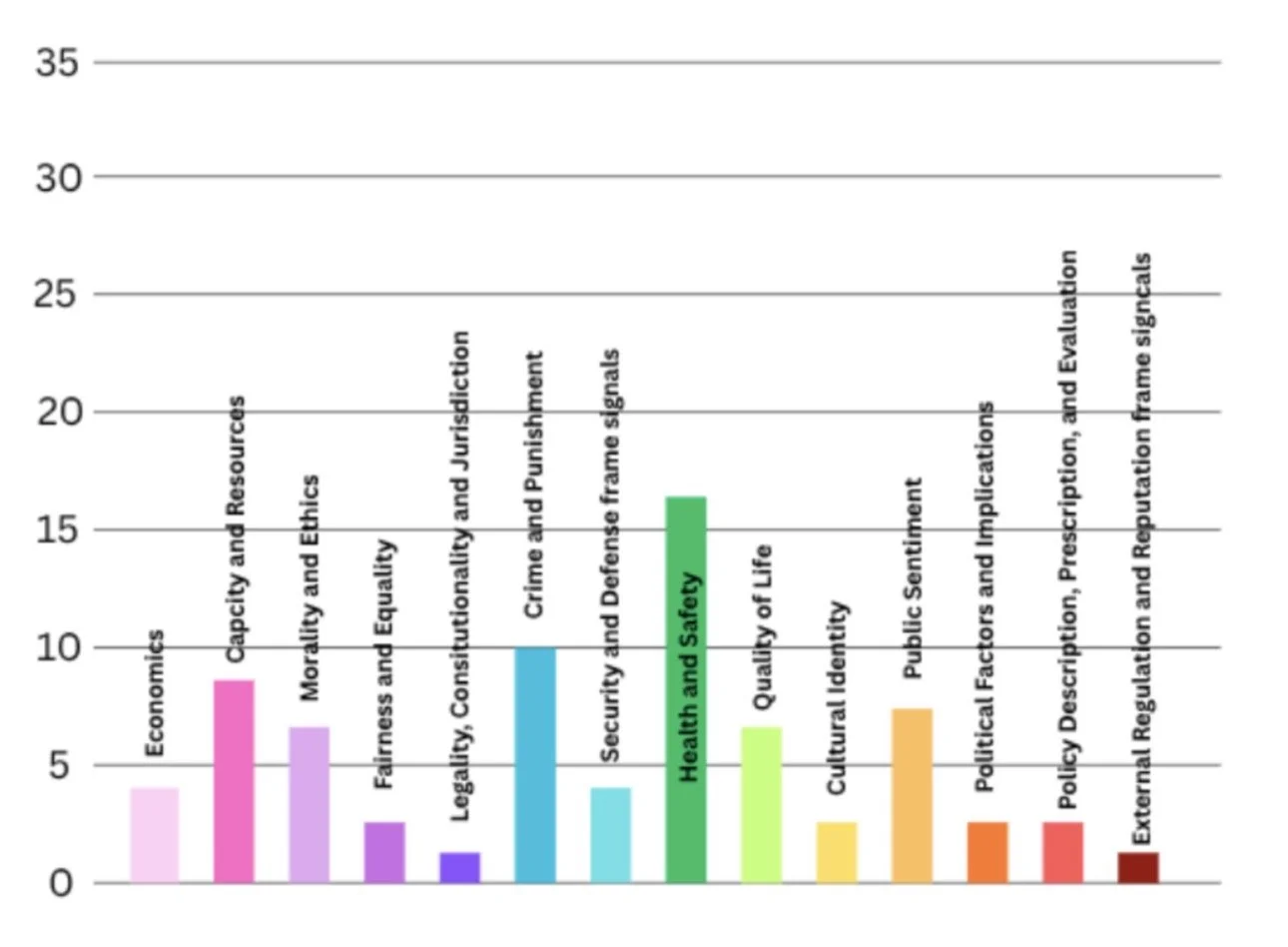
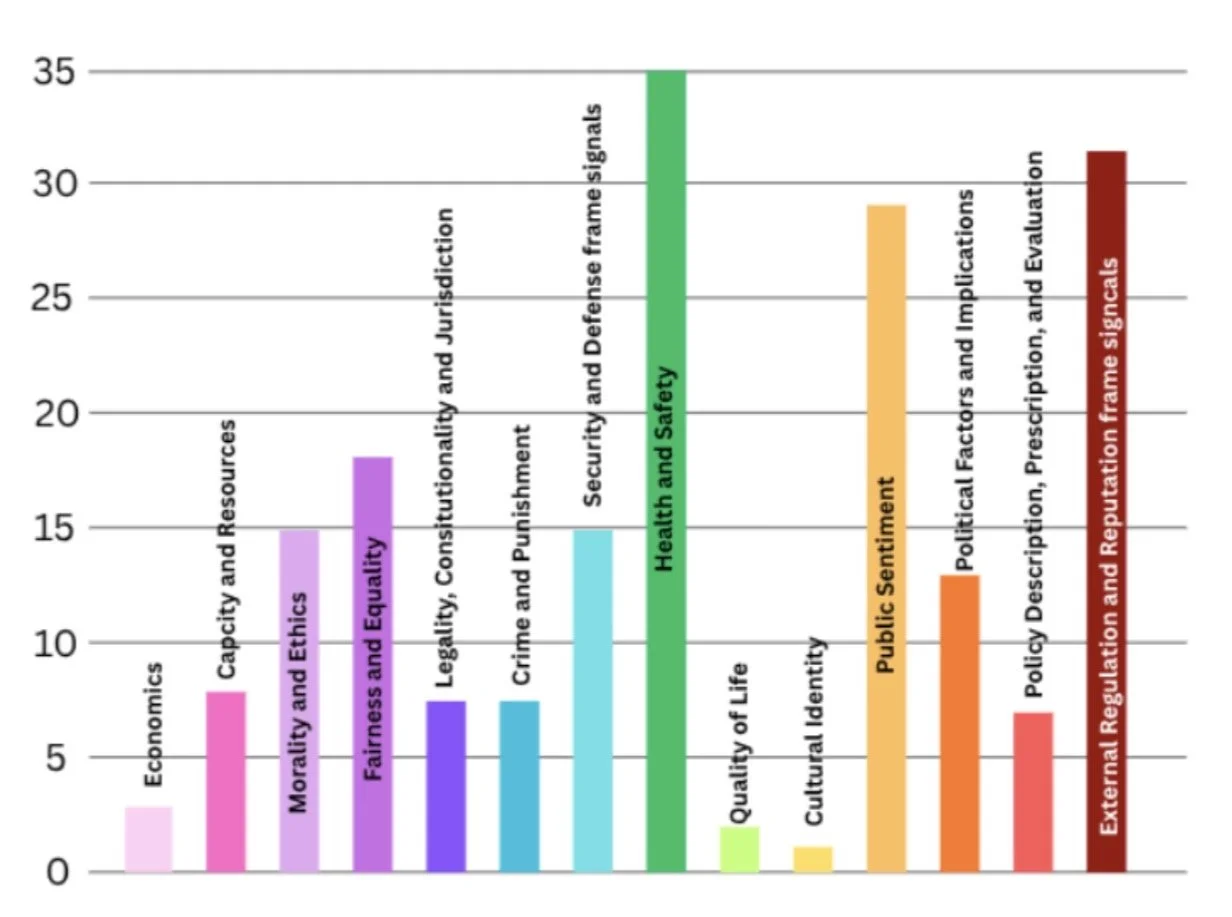
The objective of this study was to examine the frequency, contextual usage of specific political terms, ideas, and themes as seen in Chart A, between the Superman (1978) film and the Superman (2025) film through a film analysis. Data from both films were collected and analyzed. All 14/14 factors from the Policy Frames Codebook were coded for in this study. These indicators were labelled as “Economics”, “Capacity and Resources”, “Morality and Ethics”, “Fairness and Equality”, “Legality, Constitutionality, and Jurisdiction”, “Crime and Punishment”, “Security and Defense Frame Signals”, “Health and Safety”, “Quality of Life”, “Cultural Identify”, “Public Sentiment”, “Political Factors and Implications”, “Policy Description, Prescription, and Evaluation”, and “External Regulation and Reputation Frame Signals”.
As the researcher analyzed the film, lines that aligned with any of the fourteen indicators were drawn into their data. For example, in Superman (2025), the character Lois states “So, in effect you illegally entered a country, inserting yourself into an incredibly heated geopolitical situation”, which fits into the indicator of “Political Factors and Implications.” Furthermore, in Superman (1978), Luther states “But a disaster - with people in danger - people who need help…” fit into the indicator of “Morality and Ethics”. The researcher coded lines that correlate with these indicators for both films and then utilized the data to calculate the difference between both films.
CHART A: Depiction of Political Indicators coded in Superman(1978)
Chart A highlights each indicator that was used throughout the Superman (1978) film, as well as the amount of times that it was utilized. The lines coded as political/qualitative data for this movie can be found in Appendix C. The total lines in this film is 629 lines, and out of 629 lines, 75 lines were identified as political, meaning 11.9% of the dialogue was analyzed as political by the researcher. “Health and Safety” was the highest occurring indicator, for a total of 16 uses. For example, in line 350 Luther proclaims, “Within a matter of seconds a poison gas will be released that will annihilate everyone within a forty block radius”(Younis 70). Following this, “Climate and Punishment” was identified 10 times, “Capacity and Resources” 9 times, and “Public Sentiment” 8 times. In total, each indicator was used at least one time throughout the entire film.
CHART B: Depiction of Political Indicators coded in Superman(2025)
Similar to Chart A, Chart B highlights each indicator that was used throughout the Superman (2025) film, as well as the amount of times that it was utilized. The lines coded as political/qualitative data for this move can be found in Appendix B. The total lines in this film is 954 lines, and out of these 954 lines, 230 lines were identified as political, meaning 24.1% of the dialogue was analyzed as political by the researcher. Health and Safety was the most used indicator, for a total of 35 uses. For example, in line 243 Superman proclaims, “Ghurkos and his goons were going to kill people”(Gunn 67). This highlights direct threats made towards the safety of innocent civilians. Following this, “External Regulation and Reputation Frame Signals” was identified 31 times, “Public Sentiment” was identified 29 times, and “Fairness and Equality” was identified 18 times. In total, each indicator was used at least one time throughout the entire film.
CHART C: Prevalence of Political Messaging in both films
Chart C displays the percent difference in political lines between both films. Both percentages are the sum of all politically identified lines divided by the total lines written for the dialogue of each respective film. Superman (2025) was significantly higher, by around 13% more lines being identified as political by the researcher. These findings are successful in addressing the gap in scholarly studies regarding the quantitative comparison of political messaging across DC Superhero films, particularly the Superman franchise.
Analysis
As identified by the researcher, the Superman films have increased in the occurrences of politically written lines, which supports the researcher’s hypothesis that more political lines will be identified in the 2025 film. While it cannot be verified that the filmmakers intention was to persuade audiences towards a specific political ideology, the significant increase in the amount of political messaging correlates to a clear engagement with contemporary political discourse compared to the Superman (1978) film.
Throughout both films, Health and Safety was the highest indicator identified by the researcher, increasing by 19 lines in the Superman (2025) film as depicted in the data shown in Abstract B. This increase suggests that Superman’s character emphasizes the safety and health of citizens, reflecting the societal risks concerning global threats. This prominence of Health and Safety also suggests that there is continuity in the way that filmmakers want Superman to be portrayed. Similarly, "External Regulation and Reputation Frame Signals” and “Fairness and Equality” were both indicators identified by the researcher that were not as prominent in the 1978 film as they were in the 2025 film. However, the 1978 film had a higher concentration of ideas such as “Crime and Punishment” and “Capacity and Resources” compared to the 2025 film.
These results align with the idea of thematic emphasis, which professors James Decker and Jen Richrath previously demonstrated was when a film overemphasises certain ideas and themes over others (Decker 5). However, the reason as to why this occurred is still not identified. Researcher Terence McSweeney offers a potential explanation, stating that Superhero films as a whole are “a barometer of contemporary social anxieties and a reflection of cultural values” (McSweeney 1). Referring back to the parallels between Superman and its geopolitical conflict helps support the idea that Superman films are a reflection of what is happening during the time period it is written, produced, and released. Therefore, the increase in indicators such as “Health and Safety” in the 2025 film relates to the increased Health and Safety issues occurring during the Gaza Conflict. However, while this phenomenon could be a potential reason as to why specific indicators are increasing and decreasing, there is no hard evidence from directors or scriptwriters of the franchise correlating to the fact that these movies are parallels to their geopolitical conflict. Thus, while this cannot be concluded from this research, what can be indicated is that political messaging increased in the Superman franchise.
This shift suggests that the modern version of the Superman franchise (Superman 2025) utilized dialogue that is strongly submerged within global political messaging compared to the prior 1978 film. While political themes in the 1978 film were present but less intense in the dialogue, the 2025 film integrates political messaging more directly and more frequently. Ergo, the researcher’s findings confirm that political messaging has increased within the Superman franchise over time.
As previously stated in the literature review, having an increased amount of political messaging can increase the potential for political socialization in adolescence. Mark Cummings also added onto this previously, highlighting that political socialization can lead to “heightened aggression and violence, revenge-seeking, insecure attachment, anxiety…” (Cummings 2). Adding on to that, researcher Melissa Humphries states that media is one of the key agents of political socialization in adolescents (Humphries 7). Consequently, with the research results found in this study, it is clear that political messaging increased in the 2025 film, aligning with the potential for political socialization to increase in the viewers of the film as well.
Conclusion and Implications
Throughout the research process, the researcher was able to gain a new understanding from the results of their data, and was able to fill the previous gap, which was the lack of research on the difference in the amount of political messaging present throughout the Superman films, more specifically the first film, Superman (1978) vs the last film, Superman (2025). After analyzing the data, the researcher was able to determine that the political messaging in the dialogue of the Superman franchise increased over time, reinforced by the idea of the higher frequency of lines in the 2025 film. The result also supported the researcher’s hypothesis, which was that more political lines will be identified in the 2025 film compared to the 1978 film. Additionally, when using the Policy Frames Codebook, the researcher found that there was a large increase in the Health and Safety factor between both films. This increases the potential of political socialization to occur in the audience, in this case adolescent viewers who more commonly watch DC Superhero films such as Superman. In addition, the increased political messaging that is implemented into these films could potentially affect the mental state of adolescence, which as proven previously by Cummings, is one of the many effects of adolescence being continuously exposed to political ideas over time. Outside of the superhero genre, these findings could also potentially display an overall trend that can be seen throughout fictional films. The results imply that as time progresses, fictional films increasingly reference political conflicts similar to that of the real world, increasing the rate of political socialization in the audiences that shape their perception of global political issues. The presence of political media may contribute to early development of political attitudes, further highlighting the importance of understanding how entertainment media such as Superman can influence the interpretation of politics for adolescence. Overall, the researcher gained a new understanding of the way fictional films, particularly the DC Superhero franchise, implement politically influenced dialogue into their films, and how the use of it changed over time. As a result, screenwriters of Superman films should adjust their dialogue in order to be less politically influenced, in order to limit the potential of political socialization. Additionally, the researcher can look to educate other DC Superhero screenwriters on the potential exposure to political ideas on audiences, and decrease the amount of political messaging in the DC Superhero franchise.
Limitations
When conducting the research, there were very relevant limitations that the researcher acknowledged. The first one being that the Superman films analyzed were two small samples, as it was 2 out of 7 films. Due to this, it cannot fully be concluded that the entire Superman franchise has increased overall in their political messaging. Although it doesn't analyze all 7 films, it is still important to note that the research displays a clear increase between Superman (1978) and Superman (2025) films. Additionally, the researcher found that Superman (2025) doesn't have much research done on it due to its recency, hence affecting the ability to justify certain things with multiple sources, such as Superman including Gaza conflict ideologies. There is also a possibility that the age rating of the Superman movies affects the amount of political messaging made in the films. Superman 2025 is rated PG-13 (13 and up), while Superman 1978 is rated PG (7 and up). In this study, adolescence is defined as children 10-19, therefore both Superman movies are suitable to be watched by adolescents. However, the difference in rating may affect the results of the study as the potential of political socialization decreases the older one gets. Additionally, the coding scheme was limited from what was taken from the “Policy Frames Codebook” by Amber E. Boydstun. The use of the Policy Frames Codebook helped provide a systematic method for identifying political messaging within the dialogue. However, while some codes included direct words to look for, other codes did not. This leaves some room for interpretation for the researcher, however, future researchers can avoid this limitation by conducting further research and applying a coding scheme that is more specified. Despite these limitations, this research has the potential to be delved into further, and may be able to provide valuable information that is effective in society.
Future Directions
This research is very valuable for the use of future researchers, and it can be built on in many different directions. One potential direction that future researchers can take from this paper is to analyze the political messaging in all 7 Superman films, to determine if there is a consistent increase throughout the franchise. For example, if a researcher analyzes all films, they are able to determine the frequency of political references throughout the entire franchise, rather than simply based on the first and last film. Additionally, future researchers can branch out and also analyze different DC Superhero franchises to determine if this frequency of political messaging is consistent through all DC Superhero franchises. Future researchers can reference this research paper for other franchises such as Wonder Women, Batman, Shazam, and many others. However, if future researchers wish to keep their research in the Superman franchise, they can build upon the researchers data by providing statistical evidence that supports or refutes whether the results of this study are by chance. In this study, the increase in political messaging does not necessarily correlate with the idea that screenwriters implemented this with intention. Conducting a statistical study on this paper will help justify the increase of political messaging in Superman (2025), as well as open a conversation on whether or not there is intention behind this increase. Future researchers could also research whether the political messaging in each film relates to its respective geopolitical issue, or whether some aspects of the film reflect on past political issues. It is necessary for political messaging to be continuously studied and brought to the attention of more people, especially when studying politics in films such as Superman. Thus, future researchers, screenwriters, and society as a whole can reflect on this study and bring awareness to the negative effects of political socialization, and how political messaging in films can affect this.
Works Cited
Asuaje, Andrea. Despite Massive Success, New “Superman” Movie Derided as Super ‘Woke’ by Right-Wing Pundits. GBH, 18 July 2025, https://www.wgbh.org/culture/2025-07-18/despite-massive-success-new-superman-movie-derided-as-super-woke-by-right-wing-pundits . Accessed 26 Apr. 2026.
Berman, Lazar. “Why Some Think the New ‘Superman’ Movie is About the War in Gaza.” Jewish Telegraphic Agency, 15 July 2025, https://www.jta.org/2025/07/15/ideas/why-some-think-the-new-superman-movie-is-about-the-war-in-gaza
Boydstun, Amber E., et al. Policy Frames Codebook. Updated July 2020, University of Texas at Austin. https://minio.la.utexas.edu/compagendas/codebookfiles/Policy_Frames_Codebook.pd
Box Office Mojo. IMDb, https://www.boxofficemojo.com/ . Accessed 26 Apr. 2026.
Cummings, E Mark et al. “Children and political violence from a social ecological perspective: implications from research on children and families in Northern Ireland.” Clinical child and family psychology review vol. 12,1 (2009): 16-38. doi:10.1007/s10567-009-0041-8
Forattini, Fernando Miramontes, and Bruno Andreotti. “Superman and Reagan’s Conservative Turn: A Reflection on the Heroic Imaginary in United States Political Culture (1978-1986).” Dominios da Imagem, vol.17, no. 33, 2023, pp. 138-157, https://ojs.uel.br/revistas/uel/index.php/dominiosdaimagem/article/view/48912
Gordon, Ian. “Truth, Justice, and the Human Way in James Gunn’s Superman.” Public Humanities 1 (2025): e156. Web.
Gunn, James. Superman. Superman.com, https://www.superman.com/script/supermanscript.pdf. Accessed 26 Apr. 2026
Humphries, Melissa et al. “The Political Socialization of Adolescent Children of Immigrants.” Social science quarterly vol. 94,5 (2013): 1261-1282. doi:10.1111/ssqu.12025
Leshem, Bar. “Visualizing Superman: Artistic Strategizing in Early Representations of the Archetypal Man in Comic Books.” Arts, vol. 10, no. 3, 2021, p.62 https://doi.org/10.3390/arts10030062
Liu, Yijun. “Political Socialization and the Impact of Media on Kids and Adults.” Perspective, vol. 16, no.3, 2022, pp.1
Maruo-Schröder, Nicole. ““Justice Has a Bad Side”: Figurations of Law and Justice in 21st-Century Superhero Movies.” European Journal of American Studies, no. 13-4, 30 Dec. 2018, https://doi.org/10.4000/ejas.13817
McNair, Brian. An Introduction to Political Communication. 6th ed., Routledge, 2018.
Owiredu, Maria. “‘Ideology and Religion’ How Left‐right Ideology Plays a Key Role
in Attitudes toward Israel and Palestine in Sweden.” Scandinavian Political
Studies, vol. 47, no. 4, Dec. 2024, pp. 672–95. EBSCOhost,
https://doi.org/10.1111/1467-9477.12289.
Rideout, V.J., Ulla G. Föhr und Donald F. Roberts. Generation M2: Media in the Lives of 8- to 18-Year-Olds. Henry J. Kaiser Family Foundation, Jan. 2010.
Romijn, Peter, et al., editors. Divided Dreamworlds?: The Cultural Cold War in East and West. Amsterdam University Press, 2012. JSTOR, http://www.jstor.org/stable/j.ctt6wp6mh . Accessed 1 Dec. 2025.
Salminen, Janne. “Superman on the Silver Screen: The Political Ideology of the Man of Tomorrow on Film.” WiderScreen, vol. 20, no. 3, 2017, http://widerscreen.fi/numerot/2017-3/superman-silver-screen-political-ideology-man-tomorrow-film/.
“Why Superheroes Matter in Modern Society.” Toxigon Blog, 26 Mar. 2025 https://toxigon.com/why-superheroes-matter-in-modern-society.
World Health Organization. Adolescent Health. World Health Organization, https://www.who.int/health-topics/adolescent-health . Accessed 26 Apr. 2026
Younis, Steve, editor. “Superman: The Movie Transcript.” Superman Homepage, https://www.supermanhomepage.com/movies/movies.php?topic=m-movie1-transcript. Accessed 26 Apr. 2026
Appendix
APPENDIX A
Factors
Definition
Language in Show
Economics
“The costs, benefits, or any monetary/financial impactions of the issue (to an individual, family, organization, community or to the economy as a whole)” (Boydstun 5).
Capacity and Resources
“The lack of --- or availability of --- time, physical, geographical, space, human, and financial resources, or the capacity of existing systems and resources to implement or carry out policy goals” (Boydstun 5).
Morality and Ethics
“Any perspective that is compelled by religious doctrine or interpretation, duty, honor, righteousness, or any other sense of ethics or social or personal responsibility” (Boydstun 7).
Fairness and Equality
“The fairness, equality, or inequality with which laws, punishment, rewards, and resources are applied or distributed among individuals or groups” (Boydstun 8).
Legality, Constitutionality and Jurisdiction
“The legal, constitutional, or jurisdictional aspects of an issue, where legal aspects include existing laws and court cases; constitutional aspects include all discussion of constitutional interpretation and/or potential revisions; and jurisdiction includes any discussion of which government body should be in charge of a policy decision and/or the appropriate scope of a body’s policy reach” (Boydstun 9).
Crime and Punishment
“the violation of policies in practice and the consequences—retribution—of these
Violations” (Boydstun 11).
Security and Defense Frame Signals
“any threat to a person, group, or nation, or any defense that needs to be taken to avoid that threat.” (Boydstun 12)
Health and Safety
“the potential health and safety outcomes of any policy issue” (Boydstun 13)
Quality of Life
“the benefits and costs of any policy on quality of life” (Boydstun 14)
Cultural Identity
“the social norms, trends, values and customs constituting any culture(s) (American or otherwise), as they relate to a specific policy issue.” (Boydstun 15)
Public Sentiment
“the public's opinion” (Boydstun 17)
Political Factors and Implications
“any political considerations surrounding an issue” (Boydstun 18)
Policy Description, Prescription, and Evaluation
“existing policies, policies proposed for addressing an identified problem, as well as analysis of whether hypothetical policies will work or existing policies are effective” (Boydstun 19)
External Regulation and Reputation Frame Signals
“the United States' external relations with another nation; the external relations of one US state with another” (Boydstun 21)
APPENDIX B
Indicator
Dialogue from 2025 film (Gunn 1-131)
Economics
“You can afford thousand- dollar concert tickets for your new girlfriend, but you can’t make your child support payments? Jerk.” (330)
“So Luthor gave them arms for free? For what?” (479)
“Luthor has been selling arms to Ghurkos for pennies on the dollar for years.” (790)
Capacity and Resources
“I know, Lex. I’ve sacrificed my own humanity to help get rid of it.” (308)
“How is that a mystery? LuthorCorp sells arms to Boravia. Boravia gets into a war, Luthor sells more arms and gets richer than ever.” (475)
“I have a connection at BodaBank. Boda handles the transactions between LuthorCorp and Boravia. Yes, LuthorCorp has sold them approximately eighty-billion dollars’ worth of arms. But Boravia, for those arms, has only paid one point six two five billion dollars.” (478)
“He did it in exchange for half of Jarhanpur.” (793)
“At first I thought Eve was just sending me selfies. But in the background of the shots are maps,
contracts, all kinds of documents chronicling Boravia’s agreement to cede half of the country to Lex Luthor once the invasion is complete." (795)
“Eve’s photos show he’s behind the Hammer of Boravia scam -”
“Whatever you do to me, Luthor… your plans in Boravia... won’t work.” (864)
“I think you overestimate the importance of Jarhanpur to me, Superman.” (876)
Morality and Ethics
“I wasn’t representing anyone but me and - good, being good, that’s all -” (245)
“They sent me here to serve humanity, and help the world be a better place.” (278)
“I was hoping we could capture it and, you know, bring it to an intergalactic zoo or... at least euthanize it more painlessly.” (351)
“- twenty-eight of the world’s top linguists have confirmed the translation and thirty of the top forensic computer techs have confirmed the validity of the footage itself.” (361)
“What about the numerous kind acts Superman has performed over the years, saving people’s lives?” (374)
“The ship my parents sent me in was damaged in transit so I only ever heard the first part of the message. I always believed I knew how it ended -- my parents wanted me to serve the people of earth, to be a good man. But...I’m not here to rule over people, Lois.” (438)
“Lex tortured a dog the other day.” (524)
“Oh my God! Why does he trust everyone?!” (556)
“There are a lot of... other people... being held as prisoners in there... we need to get them out.” (703)
“Parents aren’t for telling their children who they’re supposed to be. We’re here to give ya’ll tools, help you make fools of yourselves all on your own.” (776)
“Your choices, Clark, your actions. That’s what makes you who you are.” (777)
“Brain beats brawn. Sorry, chum.” (889)
“That’s where you’ve always been wrong about me, Lex. I’m as human as anyone.” (910)
“I love it. I get scared. And each day I wake up and despite not knowing what to do I try to put one foot in front of the other and make the best choices I can. I screw up all the time. But that’s being human, and that’s my real strength.” (911)
Fairness and Equality
“No need to thank us, as we will not appreciate it, sir.” (6)
“We have no consciousness whatsoever.” (7)
“Merely automatons here to serve.” (8)
“Wait, wait, hold on a second, no. First of all, whether Jarhanpur as a country is imperfect doesn’t mean another nation has the right to invade them -” (227)
“The government of Boravia maintains they’re freeing the Jarhanpurians from a tyrannical regime.”(228)
“The people there are simple and profoundly confused, weak of mind and spirit and body. Lord over the planet as the last son of Krypton.” (371)
“Dispatch of anyone unable or unwilling to serve you, Kal-El, and take as many wives as you can so your genes and Krypton’s might and legacy will live on in this new frontier.” (372)
“Do us proud, our beloved son. Rule, without mercy.” (373)
“He’s grooming us. Lulling us into complacency so he can dominate without resistance, forging a path for his superpowered descendants to rule the earth. I will not accept that, will you?” (375)
“Right? I’ve been thinking of opening one in my half of Jarhanpur.”(406)
“No one read me my rights.” (458)
“Yes, well, the courts have decided those rights don’t apply to extraterrestrial organisms. Therefore, at this point, Superman, you don’t have any rights to read.” (459)
“They sent me here to rule over everyone... to kill people…” (733)
“You don’t understand. I’m not who I thought I was. They sent me here to hurt people.” (775)
“He wants to make himself king.” (796)
“Yes, but, as is often the case with cloning, the match was imperfect. He might be even stupider than you, if that’s possible. But easier to control -” (859)
“And stronger.” (860)
“I know you won’t kill me! You’re too delicate and weak - like Superman.” (872)
“- had Luthor on the show many times - little did we know he was a traitor buffoonishly thirsting for power!” (918)
Legality, Constitutionality, and Jurisdiction
“The Boravian government, of all people, is saying this?! See now, Lois, well, now, you, you’re being dishonest!” (231)
“You know as well as I do that Boravia is not well-intentioned!
“ (233)
“Superman, did you consult with the President before entering Boravian airspace?” (238)
“No.” (239)
“The Secretary of Defense?” (240)
“No.” (241)
“No one in the government will say. Luthor seems to be working to disable Superman just so he can’t stop the invasion of Jarhanpur. Why?” (482)
“You’d be terminated already if it was up to me. But first the government has some questions they want answered.” (501)
Crime and Punishment
“Other metahumans aren’t going off half-cocked, interfering in foreign affairs. They don’t have - and I have proof of this - a hidden headquarters in Antarctica that violates twelve international treaties. And they aren’t aliens. Shouldn’t all that be more than enough reason for PlanetWatch to at least bring the Kryptonian in for questioning?” (145)
“It doesn’t matter, Lex. Without proof of malicious intent, it’s not worth taking the risk.” (155)
“At Superman’s fortress, I hoped to get the knowledge to help destroy him - little did I know his own parents would be providing it.” (404)
“I’m gonna go. The DOJ put a warrant out for my arrest. So I’m going to turn myself in.” (451)
“The government is well aware of our potential limitations in detaining you. So, we’ve outsourced confinement and interrogation to PlanetWatch.” (460)
“Be sure to keep our guests in check. Little Joseph certainly wouldn’t want it any other way. I’ll be back tomorrow to get the answers we need.” (503)
“Because he made a point to tell me about all his ex-girlfriends he had imprisoned in his pocket universe.” (508)
Security and Defense Frame Signals
“So this guy just flew into midtown and started attacking people, demanding for Superman to show up?” (104)
“Admittedly, I’m not comfortable - nor are most of us - with a being from another planet as dangerous as him - is it? I don’t know - on the loose. But the optics - Superman is popular -” (146)
“- not to mention the potential risk in failing to contain him - “ (148)
“Ghurkos was going to kill people. You seem to keep forgetting -” (219)
“This is what you do when you’re faced with conflict, you get mad, you pout, and you pretend like nothing’s wrong!” (290)
“This is what we came for. Hopefully there’s something in this computer we can use to convince the generals Superman requires immediate action.” (305)
“I can’t stand the metahumans, but he’s so much worse... SuperMAN. He’s not a man. He's it.” (306)
“A thing with a cocky grin and a stupid outfit that’s somehow become the focal point of the entire world’s conversation. Nothing’s felt right since he showed up.” (307)
“If any of this is even remotely true, you’re exactly the kind of alien threat I was commandeered by the Green Lantern Corps to protect earth against!” (380)
“Your obsession with me is getting a little creepy, Luthor.” (464)
“This is our private correctional institution.” (496)
“Most cells are rented out to governments who want to keep their incarcerations of political agitators private. Others are for more personal transgressions.” (497)
“I really don’t understand why you stay in that relationship.” (506)
“You want us to break a federally incarcerated prisoner out of jail?” (571)
“Restricted area, pal, get back in your vehicle and get out of here.” (616)
“I’m not killing you so the Boravian military conflict can proceed. I created the Boravian military conflict so I’d have an excuse to kill you.” (878)
“- get his bald ass to Belle Reve -” (926)
Health and Safety
“Fourteen fractured bones.” (19)
“Damage to bladder-kidney-large- intestine-lungs.” (20)
“Sir, you are only eighty-three percent restored to health. (26)
You must rest.” (27)
“But this Hammer fellow just beat you at full power.” (29)
“We feed the canine, but he is unruly.(32
He realizes we are not flesh and blood.” (33)
“We couldn’t in our heart of hearts care less whether he lives or dies.” (34)
“No fatalities.” (44)
“Mali, you need to get out of here, it's not safe.” (73)
“That would mean I'd actually have to make it through your writing, Clark.” (105)
“Knowledge is worth many sacrifices, but that isn't one of them.” (106)
“Twenty-two people in the hospital, over twenty million in property damage. (107)
It makes you wonder.” (108)
“And smashed some tanks and things and a couple planes and some other stuff. (190)
There were no casualties and no significant injuries.” (191)
“I placed him against a cactus -” (209)
“A cactus? So, torture?” (210)
“I didn’t torture anyone. The spikes weren’t even that big.” (211)
“More serious than tearing up his back on a cactus?” (218)
“And then threatened to murder their head of state?” (226)
“People were going to die!” (249)
“Still can’t hide the taste of petroleum.” (485)
“Always with the freaking smirk! I swear to God, I am about two seconds away from forming a giant hammer and beating you both to death.” (579)
“Is Supes here to take over the world? I don’t know, probably not. But the risk is not worth a beef between the US government and the Justice Gang.” (580)
“I’ll be back later, with someone else you’ve chatted with, and I’ll kill them too. Maybe that reporter you always do interviews with. Maybe I’ll kill Clark Kent next.” (615)
“That’s the problem. I need to heal. I get my powers from the yellow sun... but just give me a…” (641)
“It’s Kryptonite poisoning.” (705)
“He’ll heal, but it will take a day or two. Get him someplace safe.” (706)
“This is a mandatory evacuation. Repeat: this evacuation is not optional.” (788)
“<We will not sleep until the street is flooded with the blood of every Jarhanpurian!>” (837)
“He’ll suffocate any minute.” (844)
“Kill him!” (898)
“It’s gonna reach Bakerline any minute. There are people there.” (903)
“They chose him. Let them die. We’ll close it from the bunker, before it gets to a city I care about. Open the portal!” (905)
Quality of Life
“We have searched the universe for a home where you can do the most good.” (16)
“We have searched the universe for a home where you can do the most good.” (17)
“Ghurkos and his goons were going to kill people.” (243)
Cultural Identity
“LuthorCorp state-of-the art translating software has successfully translated the Kryptonian language in the message -” (360)
Public Sentiment
“In sports writing you learn, the sentence is the modifiers.” (86)
“They won’t fool everyone forever. Plus, ethically, these interviews are more than questionable. By their very nature, you know the questions in advance.” (167)
“People on social networking sites are suspicious because you are, everyone understands, an alien.” (271)
“Because you understand, now, a lot of people are maintaining you’re here for more nefarious purposes. Hashtag Superspy. Hashtag Supershit.” (281)
“I’m scared. Because who knows how large his secret harem is already?” (377)
“I was a big Superman fan - I supported him all the time online and stuff but now, I mean, I hope he rots in hell.” (391)
“- and Superman wants to keep them enslaved! Also, from what I hear, he finds Boravian women the most physically attractive and wants to add them to his secret harem!” (393)
“I mean, it seems to me that the only rabid animal around here is Superman.” (395)
Ever since the discovery of the Kryptonian’s master plan, he’s gone off the deep end. Thoughts, Chris?” (428)
“Oh, just my Monkey-Bots, here farming outrage twenty-four-seven, trashing you online.” (491)
“You’re just trying to get information out of me!” (518)
“I’m a Green Lantern, lady. That means I took a vow not to become involved in politics.” (574)
“Don’t tell him nothing, Superman. I don’t have any family or anything.” (606)
“It’s just the smart one.” (619)
“Without Superman here to stop it this time, the Jarhanpurians don’t have much hope.” (782)
“We need you here in Metropolis, now.” (783)
“I have to get to Boravia.” (784)
“There won’t be a Boravia, or a Metropolis, or a planet earth, if you don’t get here soon. (785)
This rift is about to tear into the city. (786)
I can’t stop it. I need your help!” (787)
“- an absolute bombshell from the Daily Planet! (916)
Billionaire Lex Luthor aligning himself with a foreign entity -” (917)
“- seems like the one thing that conservatives and liberals can now agree on is that Lex Luthor sucks.” (919)
“The whole world turned against Superman, and we all owe him an enormous apology. (919)
He is, of course, the hero we always thought he was.” (920)
“Glad you’re not concerned about the metahumans, Rick. (924)
Because now it seems they’re making the rules. Rick does, in fact, look concerned.” (925)
Political Factors and Implication
“The Kryptonian’s choices are the cause of my actions today!” (43)
“So you want the Defense Department to hire your metahumans to take down the Kryptonian?” (134)
“Big Blue stopped a war. Naive, maybe. But it was well-intentioned.” (136)
“I don’t know the intentions of an unattended firehose, General Flag, I just do what I can not to be splashed.” (137)
“The country of Boravia has purchased over eighty-billion dollars worth of arms from LuthorCorp in the past two years.” (140)
“No one would profit off a war between Boravia and Jarhanpur more than you. A cynic might say getting Superman out of the way might not be bad for business.” (142)
“What’s particularly bad for business is dying. And I have a feeling that’s where we’re all headed, with the Kryptonian running wild.” (143)
“We’re gonna lock up all the metahumans now?” (144)
“It’s a lot. Today the Secretary of Defense said he was going to look into your actions in Boravia -” (183)
“I told him if he messes with Jarhanpur again he’d have to personally answer me.” (213)
“So, in effect, you illegally entered a country, inserting yourself into an incredibly heated geopolitical situation -” (220)
“It is no wonder the Kryptonian interfered with Boravia’s interests - Boravia wants to save the people of Jarhanpur -” (392)
“Superman is out of commission for less than a day, and already Boravia is pulling this crap? Right?” (473)
“His cultish acolytes believe he’s going to create a technologically-advanced utopia. But there’s a profit factor as well - the petroleum deposits alone are worth multiples of his investment. They move out the exit and ---They move up the stairs.” (803)
“All of it seems to be geared toward stopping Superman from standing in the way of the Boravian invasion, Chief.” (808)
“<Mr. President, our forces aren’t prepared to deal with metahuman anomalies - I’ve sent the word to retreat.>” (869)
“<Retreat?! NO! NO!> *” (870)
“Once you involved yourself, I knew I could easily get our government's support in nullifying you.” (879)
“I know when they mention Galileo or Einstein or one of these other twits in the same breath as me I feel the tide of vomit burn the back of my throat. But at least Galileo did something. He wasn’t some dopey Venusian catapulted onto this planet just to have the world fawn over him because his strength illuminates how weak we all really are. 12C!” (885)
“So my envy is a calling! It is the sole hope for humanity, because it is what has driven me to annihilating you! 1A.” (886)
Policy Description, Prescription, and Evaluation
“Do these Metahumans think they are a candidate for international policy!? It’s outrageou-” (80)
“I doubt his parents named him Jimmy. We have no clue what his actual goal was here-.” (113)
“- will actually cause more problems around the world, more than a war that in all likelihood would have lasted between twelve and twenty- four hours and was, practically speaking, just replacing one tyrannical regime with another?” (246)
“This guy is trying to do something!” (666)
“Guards! Hey, guards!” (667)
“Don’t patronize me, you clown! None of this matters! The government gave me the authority to kill you, if not today, then tomorr - !” (913)
External Regulation and Reputation Frame Signals
“The people of Boravia will not ignore him inserting himself into our affairs.” (38)
“You’re asserting yourself into a foreign area, Lex.”(39)
“He had no place on the battlefields of Boravia and Jarhanpur.” (41)
“The United States will continue to feel the wrath of the Hammer of Boravia--!” (70)
“As long as the alien continues to sow chaos in our homeland!” (72)
“Maybe you shoulda done that thing in Jahanpur, Superman.” (76)
“Maybe Superman- I mean he’s great, of course - but maybe he didn't completely think through the ramifications of the Batavia thing.” (110)
“I think it’s pretty obvious it was kicking Superman’s ass (113)
Retaliation for the Boravia thing.” (114)
“Show me! (115)
You show me what ties there are between Boravia and this ‘Hammer’! (116)
Someone is framing Batavia to diminish our nation in the eyes of the world!”(117)
“The relationship between Boravia and the United States has been like iron for thirty years” (125)
“Until Superman came along -”(126)
“After Superman acted with violence against our Boravian allies last week, I think it’d be worth considering.”(135)
“It’s not funny. It’s just… I mean, ‘my actions’? (184)
I stopped the war.” (185)
“Well, Boravia invaded Jarhanpur and I showed up and told them that wasn’t right.” (189)
“Did you interact at all with the President of Boravia, Vasil Ghurkos?” (192)
“After I stopped the war, I went to see Ghurkos.” (201)
“What did you mean by ‘personally answer to me’?” (216)
“- siding with a nation, Jarhanpur, which historically has not been a friend to the U.S. -” (222)
“Against a country that is technically our ally -” (224)
“Or any U.S. official before you took matters into your own hands (241)
You decided unilaterally how to handle this delicate situation?” (242)
“But what if - and I’m just saying - the results of you seemingly acting as a representative of the United States -” (244)
“Funded by the LordTech corporation, the Justice Gang has occasionally partnered with Superman, although he is not officially a member.” (332)
“I think this is all being done just to keep him from interfering with the Boravian invasion.” (573)
“Now, the U.S. government has a few questions for you.” (603)
“‘The Daily Planet has exclusively obtained information “ (811)
“ Proving billionaire Lex Luthor has been in league with Boravian dictator Vasil Ghurkos -’” (812)
APPENDIX C
Indicator
Dialogue from 1978 film (Younis 1-109)
Economics
“Some unidentified joker's been buying up thousands of acres of worthless desert at incredible prices.” (527)
“In order to make money in that game you have to buy in for a little and sell for a lot. Problem: how to make that property valuable between the time you buy and the time you sell. Now then…” (562)
“At the stupid high price he offered for this worthless piece of desert… I only hope it's Custer.” (578)
“Now all this… ... west of the Fault is the most expensive real estate in the world. Los Angeles. San Diego. San Francisco. And on the other side… is just hundreds of miles of cheap desert land.”(570)
Capacity and Resources
“The energy input to Jor-El's quarters is now in excess. Our Data indicates the loss is due to a mis-use of energy.” (39)
“At last it's official! Thanks to the generous help of our own government, we are finally going to realize the greatest real swindle in history!” (190)
“You and your real estate. Why does it mean so much to you? All the time, "land, land, land." (191)
“When I was a mere prodigy, Miss Teschmacher, having passed through vandalism with flying colors at the age of six, my father said to me: "Son, stocks will rise and fall… Utilities and transportation systems may even collapse, and people are no damn good - but they'll always need land, and for that they'll pay, through the nose. (192)
Remember that," my father said. "Land."(193)
“It is their habit to abuse their resources in such a way.” (274)
“The fault line is unstable and shifting which is why you get earthquakes in California from time to time.” (569)
“... drop into the Sea! Bye-bye California! Hello new West Coast! My… West Coast.” (572)
“... no oil, no uranium, no coal, no precious minerals... hell, no water anymore… Not since the government dammed it all up…” (576)
Morality and Ethics
“You would accuse me of insurrection? Has it now become a crime to cherish life?” (23)
“See if you can just explain to me one thing. Why do millions of people have to die for this... Crime of the Century? Tell me that, Lex. Why do they all have to die?” (182)
“Lastly - do not punish yourself for your feelings of vanity. (278)
“I'm here to fight for truth, justice, and the American way.” (433)
“You'll wind up fighting almost every elected official in this country.” (434)
“Miss... Teschmacher... please... you can't... stand by... and let millions of people... innocent people... die…” (602)
“My mother comes first, promise me. I know you wouldn't break a promise.” (607)
Fairness and Equality
“I swear it! No matter that it takes an eternity! You will bow down before me... Both you, and then one day, your heirs!” (9)
Legality, Constitutionality, and Jurisdiction
“I wouldn't do that. It's against the law.” (439)
Crime and Punishment
“And finally on General Zod - Once trusted by this Council, charged with maintaining the defenses of the planet Krypton itself - the chief architect of this intended revolution, the author of this insidious plot to establish a new order among us - with himself as absolute ruler.” (1)
“An unpleasant duty has been masterfully performed, Jor-El. They have received the fate they deserved - isolation in the Phantom Zone - an eternal living death.” (10)
“A... chance for life, nonetheless. As opposed to us.” (11)
“Jor-El, be warned. The Council has already evaluated this... outlandish theory of yours.” (13)
“This discussion is terminated! The decision of the council is final. (pause - to JOR-EL) Any attempt by you to create a climate of fear and panic among the populace must be deemed by us an act of… insurrection.” (22)
“You... would be banished to endless imprisonment in the Phantom Zone - the eternal void which you yourself discovered.” (24)
“He knew the penalty he faced. Even as a member of this Council. The law will be upheld.” (42)
“Sick.Here we sit, Miss Teschmacher, mere days away from executing The Crime of the Century, and how do you choose to congratulate the greatest criminal mind of our age? Do you call me brilliant? A bit obvious, that, I grant you. Charismatic, then? Fiendishly gifted?” (177)
“People break into a museum in the dead of night - kill two guards - and what do they take? Some worthless hunk of meteorite. How do you figure it out?” (529)
“Hello, Warden. I think these men should be safe here with you until they can get a fair trial.” (626)
Security and Defense Frame Signals
“Listen, mister. I realize times are tough for some these days, but… This isn't the answer. You can't solve society's problems with a gun.” (152)
“I mean, to commit the Crime of the Century, a man would just naturally have to face - the Challenge of the Century.” (297)
“This country is safe again, Superman – thanks to you.” (628)
Health and Safety
“You can't ignore these facts! It's suicide! Worse! Genocide!” (12)
“"And the people on the street, the little man who runs the corner newsstand, the old lady sunning herself on the stoop, the kids playing stickball in the alley - none of them will ever forget that night of senseless blood- letting which turned a friendly block party into a cruel and unspeakable massacre." (120)
“Chief, this could be the basis for a whole series of articles - "Making sense of senseless killings", you know? We get psychiatrists...sociologists, interviews with the families…” (130)
“Somewhere inside that warehouse is a pellet filled with a propane lithium compound. At precisely twelve noon it will drop into a beaker of acid.” (349)
“Within a matter of seconds a poison gas will be released that will annihilate everyone within a forty block radius…” (350)
“You really shouldn't smoke, you know.” (401)
“Don't tell me. Lung cancer, right?” (402)
“But because of its high level of specific radioactivity - to someone from the planet Krypton - this substance would be lethal!” (488)
“Fast? When a woman's life is at stake? And that's about all I got left to lose, believe me.” (508)
“... here at Danforth Proving Grounds for the launching of two XK1O1 rockets, the very latest weapon in our arsenal of defense…” (520)
“It is claimed that the XK101 can hit any target completely undetected since it flies well below all radar systems yet designed…” (521)
“In approximately five minutes a poisoned gas pellet containing a propane lithium compound will be released through thousands of air ducts in this city…” (535)
“But a disaster - with people in danger – People who need help…” (538)
“Is that how a warped brain like yours gets its kicks? By planning the death of innocent people?” (552)
“No. By causing the death of innocent people.” (553)
“Most of California would be destroyed! Millions of people would be killed! The West Coast as we know it would…” (571)
Quality of Life
“He will need that advantage to survive. Their atmosphere will sustain him…” (31)
You will make my strength your own, see my life through your eyes, as your life will be seen through mine. The son becomes the father, the father becomes the son. This is all that I can send with you, Kal-El. And not near so rich a gift as that your mother sends along. Her... love.” (43)
Lead by inspiration. Let your actions and ideals become a touchstone against which mankind may learn how to serve the common good. While it is forbidden for you to interfere with human history itself, your leadership can stir others to their own capacity for moral betterment…” (110)
The human heart on your planet is still subject to small jealousies, lies, and monstrous deceptions. Resist these temptations as you inevitably find them - and your ethical power will then properly outweigh your physical advantage over others…” (111)
Now it is time for you to return to the world which I have chosen for you. When new questions arise, come back to me and I will try to be of help…”(112)
Your being is both separate and your own, but I have caused your earthly presence and must share responsibility for your actions. They can be great people, Kal-El. They wish to be. They only lack the light to show the way. For this reason above all - their capacity for good - I have sent them to you. My only son.” (113)
“Really, Lois. Supposing that man had shot you? Is it worth risking your life over ten dollars, two credit cards, a hairbrush, and a lipstick? I mean…” (161)
“And this - is California. The richest, most populous state in America.” (565)
Cultural Identity
“You'd cut a baby's throat with its own diaper pin. Steal the wafer from a nun's handbag…” (207)
“Second: Your enemies will discover their only way to hurt you - by hurting the people you care for.” (276)
Public Sentiment
“A good reporter doesn't get the great stories, Jimmy. A good reporter makes them great.” (122)
“You're perverted. You're the most cruel and vicious human being I know…” (206)
“As further accounts pour in, speculation has arisen that this whole thing may be some sort of fantastic hoax…” (283)
“... His question is everybody's: True or false? Miracle or fraud?” (286)
“Thousands of innocent lives hang in the balance. I make this gesture as a public service, by the way - and without thanks. Thanks.” (352)
“Well, I shouldn't think he'd lend himself to any cheap promotion schemes…” (375)
“And you, Warden. And the fireman, the doctor, the teacher, the clergyman – the cop on the beat… We're all on the same team.” (629)
Political Factors and Implication
“If a man didn't know better, he'd think Detroit made those things to blowout on purpose.” (47)
“I don't know, Lois, but I do know a fraud when I hear one. This thing goes against all natural laws.” (339)
Some people can read War and Peace and come away thinking it was a simple adventure story. (473)
Policy Description, Prescription, and Evaluation
“I would remind the tin-plated minions of law that this warehouse has been fitted with anti-personnel devices, which will render any police action totally ineffective…” (351)
“So it's become important for me to have very close relations with the press.” (400)
External Regulation and Reputation Frame Signals
“And even you can't fly fast enough to stop both of them!” (585)